

- Appearance:
- Hiromasa Ishiyama, the 10th Grand Master of the Bushu Sato-Kagura "Ishiyama Shachu"
- Program:
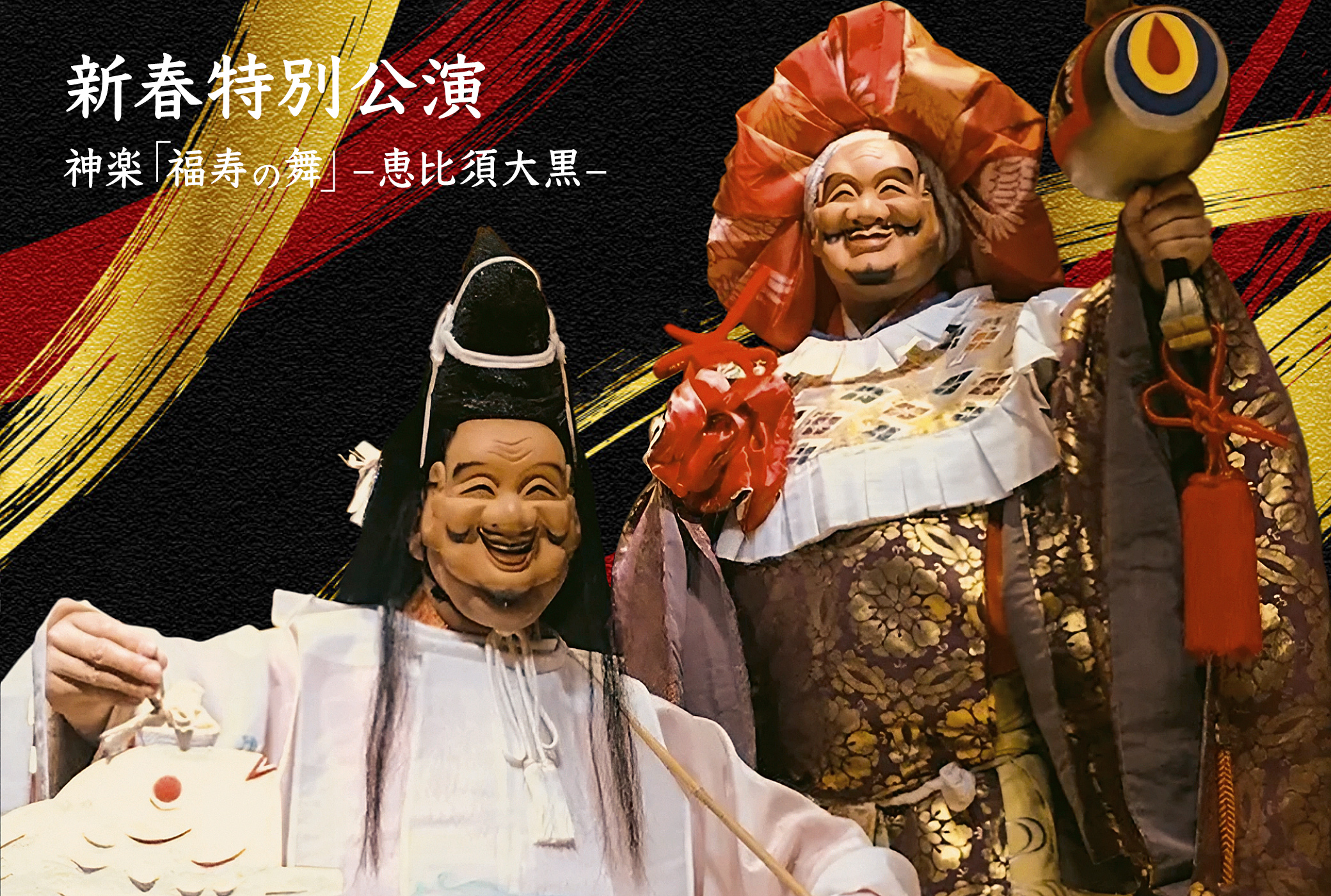
- "Fukuju no mai" – Ebisu-daikoku –
- Cuisine:
-
[Day & Night part]
Kakyo, Fūshikaden
As we ring in the New Year, SUIGIAN offers its guests a special gift. We are pleased to offer "Urakasumi" to guests viewing the Kagura performance and to other interested guests, at no additional cost from the regular menu.
The concept of this Kagura performance is "A New Year's Celebration."
The program, "Fukuju no mai" – Ebisu-daikoku –, is associated with New Year's festivities and the Fukutoku Shrine. This is the opening day of the "New Year's Special Performance" at SUIGIAN, a very festive "Kagura-zome" performance to start the New Year.
Ebisu will catch a large sea bream, and Daikokuten will bestow treasures with his Uchide-no-Kozuchi (a small mallet). We invite you to SUIGIAN to celebrate the beginning of the New Year by basking in the spirit of Ebisu Daikoku, a deity that brings prosperity to companies, families, and businesses.
We will prepare our signature course meals with special arrangements and decorations that elevate the spirit of the New Year. During the event, you may enjoy the famous sake "Urakasumi" with your meal, which will be offered free of charge to those who wish to enjoy it as our treat to you for the New Year.
This is a one-of-a-kind opportunity for fans of sake.
* A complimentary "Urakasumi" pairing set will be offered to customers who wish to order.
Please order beer, wine, and non-alcoholic drinks separately from the menu inside the restaurant.
* Ebisu: One of the "Seven Lucky Gods" known for bringing prosperity to businesses and produce bountiful catch and harvest.
The "Seven Lucky Gods" are a group of seven deities, each with different divine qualities, who are a familiar existence to the Japanese who have worshipped the deities for centuries.
* Daikokuten: A god who controls the land (agriculture) and, like Ebisu, is one of the "Seven Lucky Gods" and is considered a god of happiness and good fortune.
He is generally depicted as a figure carrying a large sack on his back, holding a mallet and wearing a tokin on his head. He is believed to be the god of wealth, prosperity, and good fortune.
This event ended on January 3rd (Tue)
Thank you for coming