

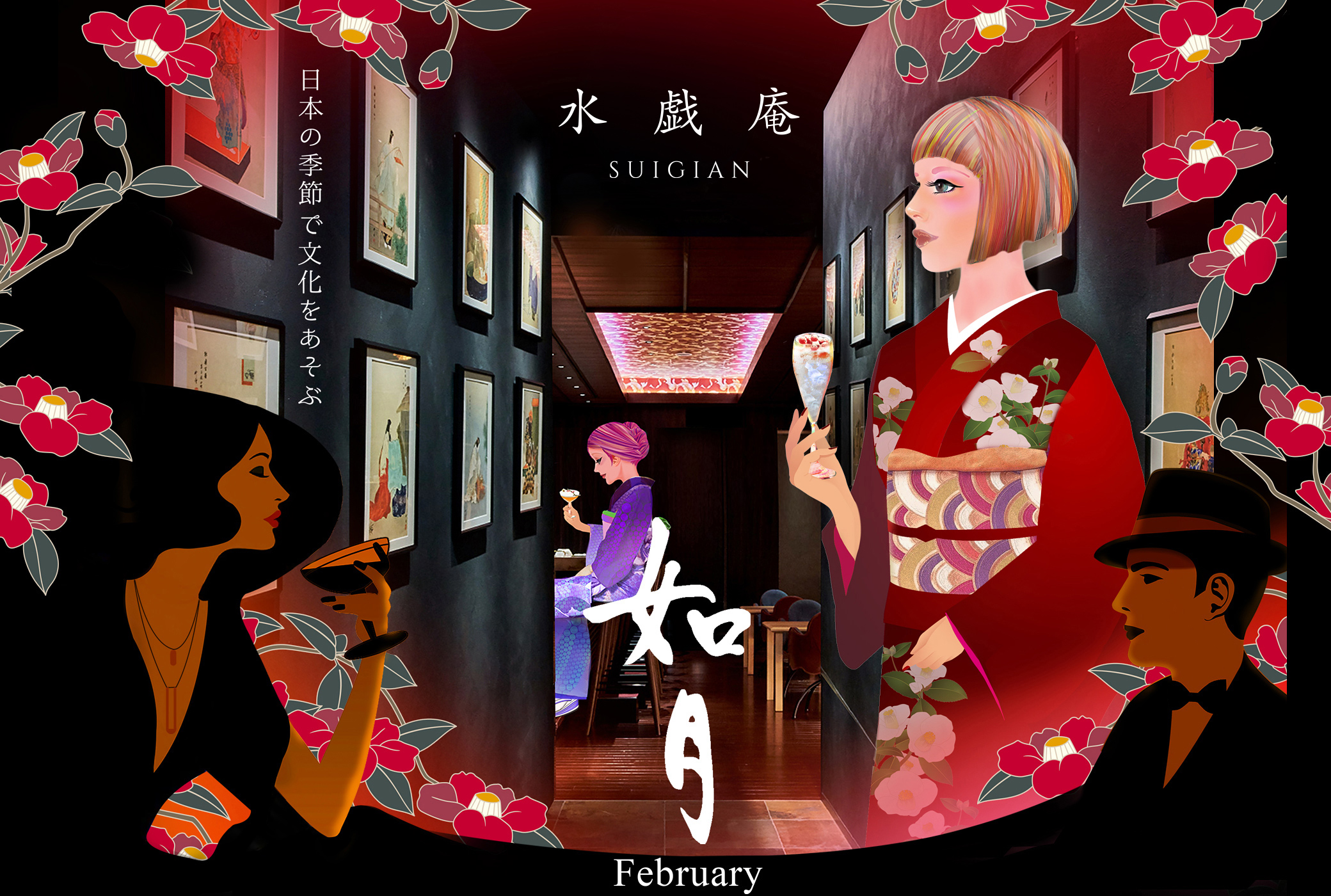
This month is February, "Kisaragi."
According to the old Japanese calendar, it is February 4th, known as “Risshun,” that marks the start of the year.
In addition, February 5th is the first “Day of the Horse,” or “Hatsuuma,” a day on which a festival dedicated to Inari Okami is held at Inari shrines all over Japan in order to pray for abundant harvests, business success, better fortune, and the well-being of one’s family.
Furthermore, February 8th is known as “Kotoyōka,” a day that marks a turning point for wrapping up and beginning events or agricultural activities.
SUIGIAN is located on the premises of the ancient and honorable Mebuki Inari, also known as Fukutoku shrine.
At SUIGIAN, where we play with culture in accordance with the old Japanese calendar’s 24 seasons and 72 micro-seasons, you can experience the joy or starting the new year all over again.
Along with a visit to Fukutoku shrine (Mebuki Inari), we would love to have you welcome a Japanese-style start to the new year with us.
* Hatsuuma: known as the day when the kami presiding over agriculture flew down to Kyoto’s Fushimi Inari Taisha. Since then, this day has spread across Inari shrines all over Japan as a festival day.
24 seasons
Daikan (Greater cold)/
January 20th to February 3rd
Risshun (Beginning of spring)/
February 4th to 18th
Usui (Rainwater)/
February 19th to 28th
[ The 24 seasons and 72 micro-seasons ]
Now four seasons are standard, but in ancient Japan the spring, summer, fall and winter were divided into 24 seasons, and each of those 24 seasons was further divided into 3 smaller seasons of 5 days each, called the 72 micro-seasons.
This helped people sense the changing seasons.